How many calories to burn to lose 1 kg?
Created Updated
 By Oleksandr YashchukFounder & Product Owner at TrackAI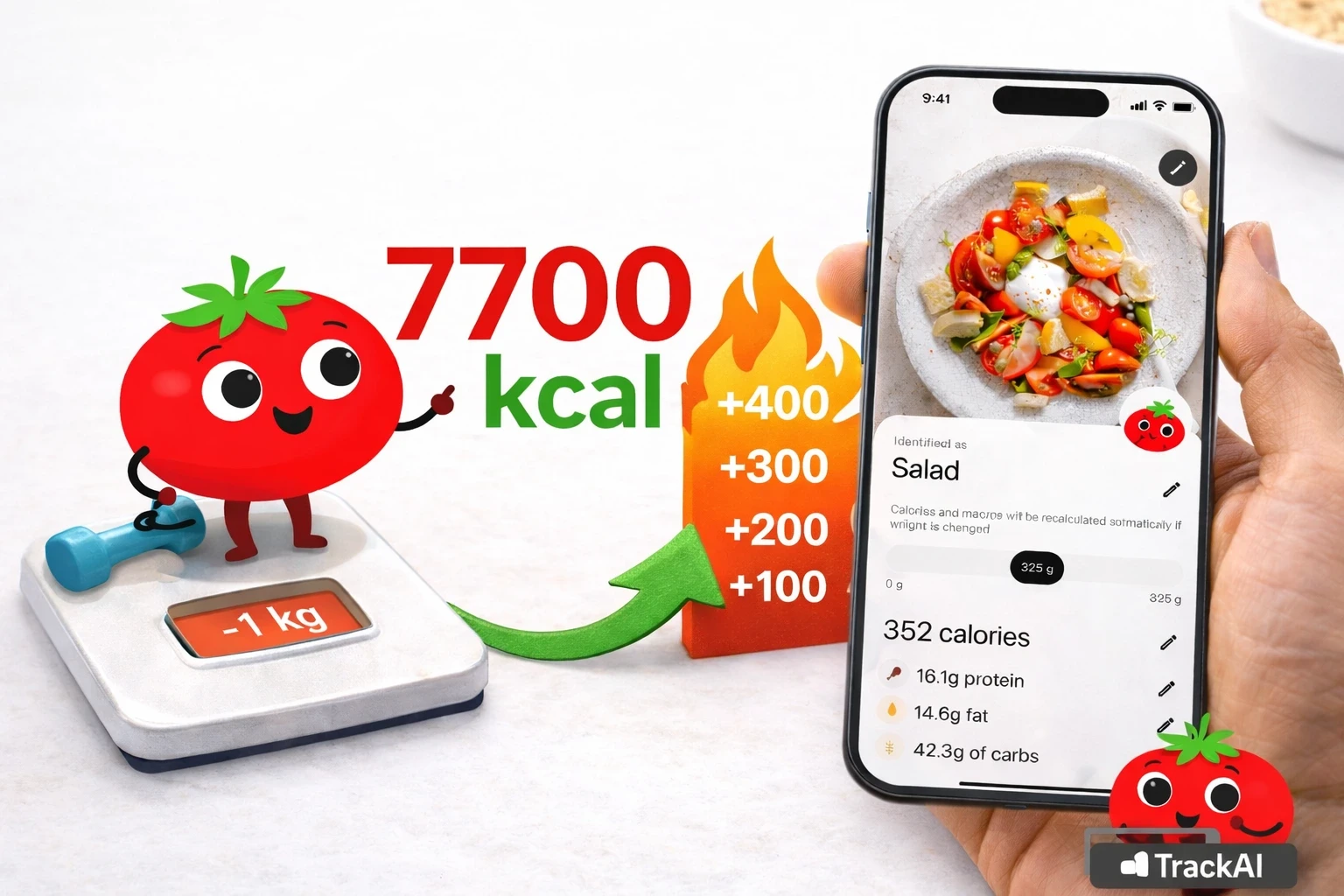
How many calories do you need to burn to lose 1 kg?
When we set a goal to lose weight, the first thing that comes to mind is numbers. How much do you need to run? How much can you eat? And the most important question that concerns most people: how many calories to burn to lose 1 kg? However, the path to slimness is not just about exercising or restricting food. It is about the overall energy balance of your day.
In this article, we will explore how our body works, why exhausting workouts don’t always yield results without proper nutrition, and how to achieve your goal without harming your health.
How the Fat-Burning Process Works
Many people imagine fat burning as a process that happens directly during physical activity: you sweat – you lose weight. In reality, it's a bit more complex. Fat doesn’t "melt" or evaporate instantly.
Fat cells (adipocytes) store energy in the form of triglycerides. For the body to start using them, a need for additional energy must arise – a calorie deficit. After that, the biochemical process of lipolysis begins: fats are broken down into fatty acids and glycerol, enter the bloodstream, and are used by muscles or other organs as fuel.
It is important to understand: the body consumes its reserves only when the amount of energy coming from food is less than the energy spent on vital functions.
How Weight Differs from Fat
People often confuse weight loss with fat burning. However, this is a common mistake. So, when you see a decrease of one kilogram on the scales in 1-2 days, it doesn’t necessarily mean that fat mass has decreased. Body weight is also influenced by the amount of water in the body, glycogen, and intestinal contents.
For example, in the morning, we may "weigh less" due to the loss of fluids and bowel and bladder emptying. However, after a salty dinner (due to water retention) or after intensive strength training, weight increases. In both cases, however, fat mass remains unchanged.
Calories IN vs Calories OUT: Why the Body Loses Weight
There are no magical foods that burn fat, or special exercises that eliminate belly fat. It is only the ratio of “calories in” and “calories out.” That is, our body loses weight only when we burn more energy than we consume with food. This is called a negative energy balance.
If you want to delve into the topic of energy intake tracking, we recommend reading our article “How to Count Calories: A Step-by-Step Guide for Beginners.”
Why Exercise Without Proper Nutrition Doesn’t Work
The most common mistake beginners make is overestimating the impact of exercise. In reality, it is almost impossible to get rid of excess kilograms solely through sports without proper nutrition. So, just because you’ve had a great workout today doesn’t mean you can indulge in a pizza. Modern food is very caloric, and during physical activity, we burn much less energy than we think.
Unfortunately, even intense workouts can be easily negated by a small “food bonus.”
| Exercise (30 minutes of activity) | Calories burned (approx) | Equivalent in food (what compensates the effort) |
| Jogging | ~250–300 kcal | Chocolate croissant or 70g chips |
| Strength training | ~150–200 kcal | Sweet latte with syrup |
| Yoga / Pilates | ~100–120 kcal | Banana or glass of juice |
| Swimming | ~250–350 kcal | Slice of pizza |
This doesn’t mean that exercising is not necessary. It means that your diet is the foundation, and exercise is a tool for improving body quality and speeding up metabolism.
How to Determine How Many Calories You Burn Per Day
Managing your weight is not difficult if you know your starting point. And that is your total daily energy expenditure (TDEE). TDEE shows how many calories you burn on average per day, considering your work, workouts, and daily movement.
To determine your TDEE, you need to calculate your basal metabolic rate (BMR) and multiply the result by the physical activity coefficient. For how to do this, check our article: "Daily calorie intake: how to calculate and how much you need."
How Many Calories Need to Be Burned to Lose 1 kg: The Formula
Let’s get to the main number. One kilogram of pure fat contains 9000 kcal. However, human fat tissue is not 100% fat; it also contains water and protein structures. Therefore, it is generally accepted that the energy value of 1 kg of fat tissue is approximately 7700 calories.
So, the formula is simple: to burn 1 kilogram of fat, you need to create a deficit of 7700 kcal. This can be done in a week, two weeks, or a month – depending on your strategy.
Deficit Calculation: Results for a Day, Week, and Month
You already know how much of a calorie deficit necessary to lose 1 kg of fat. However, do not think that you need to burn all 7700 calories in one day – this is dangerous! A sensible approach is to break this big number into small daily steps.
Time for Weight Loss: How Quickly Will You Lose 1 kg of Fat?
| Daily Deficit (kcal) | Deficit for the Week (kcal) | Projected Fat Loss for the Week (kg) | Projected Fat Loss for the Month (kg) | Safety and Comfort Rating |
| 300 | 2100 | ~0.27 | ~1.08 | Hardly noticeable for the body, ideal for beginners. |
| 500 | 3500 | ~0.45 | ~1.8 | Optimal. The golden standard of weight loss. |
| 770 | 5390 | ~0.7 | ~2.8 | The upper limit. Acceptable for people with a large amount of excess weight. |
| 1100 | 7700 | ~1.0 | ~4.0 | Dangerous. High risk of muscle loss and health problems. |
We recommend burning 500-1000 more calories than you consume (combined from food and activity), but not exceeding these limits. For more detailed information on how not to harm yourself, refer to our article “How to calculate calorie deficit for weight loss: a simple formula”
Exercise or Nutrition: What Affects Fat Loss More When Losing 1 kg
If the question is how many calories do I have to burn to lose 1 kg faster, the answer will always favor controlling nutrition.
Why? Because it is much easier to reduce consumption by 250-300 calories (for example, by skipping dessert) than to burn them off (since it takes about half an hour of intense exercise).
Nutrition starts the weight loss process, and physical activity’s task is to speed up metabolism, support muscles, and overall health. The optimal strategy is a combination: moderately reduce food intake and add physical activity.
How Many Calories Do Different Exercises Actually Burn? (Activity Table)
To realistically assess your contribution through sports, take a look at energy expenditure. Keep in mind: a person with more body mass burns more energy for the same activity.
| Type of Activity (1 Hour) | Calories Burned (Weight ~60 kg) | Calories Burned (Weight ~80 kg) |
| Walking (medium pace) | ~200 | ~280 |
| Running (8-9 km/h) | ~550–600 | ~750–800 |
| Strength Exercises | ~300 | ~400 |
| Swimming (active) | ~400–500 | ~550–650 |
| House Cleaning | ~180 | ~240 |
| Yoga / Stretching | ~150 | ~200 |
As we can see, physical activity is a great helper, but creating a large calorie deficit solely through it is very difficult.
How to Track Progress and Not Give Up
Progress in weight loss is not a straight line going down. It is a wave-like process. So, to avoid losing motivation:
- Don’t focus solely on weight. Take body measurements with a tape measure.
- Take photos. Visual changes are often more noticeable than numbers.
- Use modern technologies. For example, the TrackAI app will help you easily control the number of calories in dishes and track the balance of macronutrients without complex manual calculations.
- Analyze average values. Compare your average weight for this week with the average weight of the last week.
What to Do if Your Weight “Stalls”
The “plateau” effect is normal. Often the body retains water, masking fat loss. This can happen due to stress, salty food, the menstrual cycle phase, or even delayed onset muscle soreness after a workout.
If your weight has stalled for 2-3 weeks, try recalculating your norm (since a smaller body requires less energy) or add some variety to your activity, such as more walking.
Why It’s Important Not to Expect Daily Weight Loss
Fluctuations of 1-2 kg per day are perfectly normal. You drank more water, ate carbs (which retain fluid), didn’t sleep enough – and suddenly your weight goes up. But this is not fat.
Focus on the dynamics over 1-4 weeks. Steady, slow reduction is a sign that you are burning fat.
Common Mistakes When Trying to Lose Weight
On the path to shedding excess weight, many people make the same mistakes. Here’s what to avoid:
- Too large a calorie deficit. Starvation slows down metabolism and leads to breakdowns.
- Overestimating exercise. The idea of “I ran – I can eat a cake” often leads to a calorie surplus instead of a deficit.
- Strict diets. Giving up favorite foods creates psychological pressure. It’s better to fit a small treat into your limit.
- Eliminating carbohydrates. This gives a quick water loss, but not fat. Reintroducing carbs into your diet will quickly lead to weight regain.
- Ignoring sleep. Lack of sleep increases the hunger hormone (ghrelin), and you’ll feel hungrier.
Burning calories is tough, but entirely achievable if you move toward your goal systematically, wisely, and with love for your body.
Frequently Asked Questions
How many kcal does a person burn per day?
This value is individual and depends on gender, age, weight, and activity level. On average, women burn 1600-2000 kcal, and men burn 2000-2500 kcal, but the exact number needs to be calculated using the formula.
Is it equally effective to burn calories through cardio and strength training for losing 1 kg?
Cardio allows you to burn more calories during the workout. Strength training burns fewer calories in the moment but builds muscle mass, which helps the body burn more calories even at rest. The best option is a combination of both.
How to know if the calorie deficit is enough to lose weight?
If your weight is decreasing by 0.5-1% of body weight per week and you feel good and are not hungry, your diet is ideally tailored and your calorie deficit is sufficient.
Does the number of steps you take affect how quickly you can lose 1 kg?
Yes. Increasing your activity from 3000 to 10000 steps can burn an additional 300-400 kcal, which will significantly speed up the result.
What to do if I burn calories during exercise but my weight is not decreasing?
If the kilos aren’t dropping, it’s likely that you’re compensating for the calories burned with food without even realizing it. Check your total daily calories – perhaps you’re eating as many as you’re burning. Add more protein-rich foods to your diet and reduce fats. Try tracking your nutrition accurately for a week.