Daily calorie intake: how to calculate the number of calories for your body
Created Updated
 By Oleksandr YashchukFounder & Product Owner at TrackAI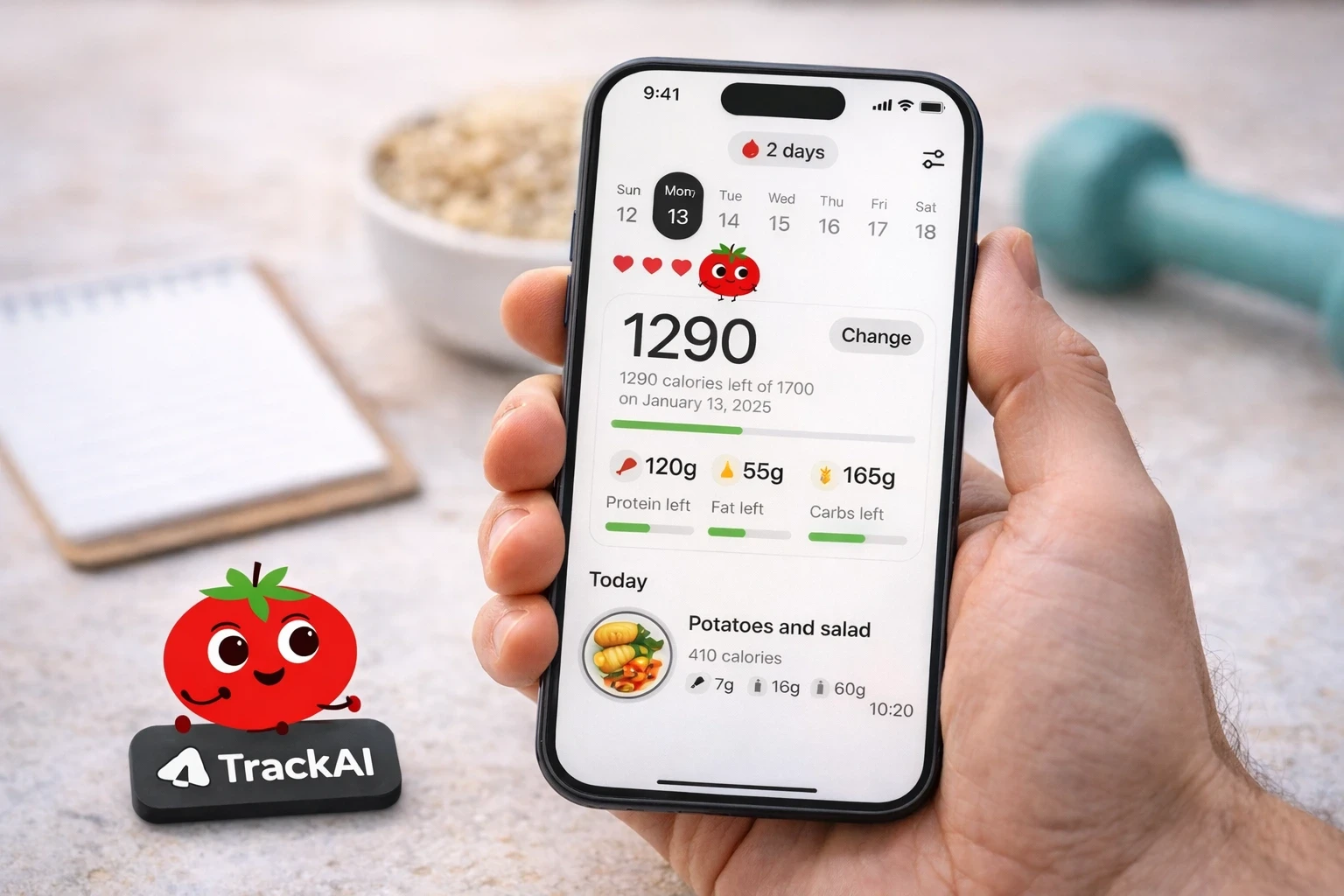
Daily calorie intake: how to calculate and how much you need
Daily intake is the source of life that provides the necessary energy for work, rest, and a full life. But how many calories should you eat per day to feel good, stay in shape, or achieve their fitness goals? The answer is not universal, as each body has its own needs.
This article will help you calculate the optimal number of calories, understand how metabolism works, and adjust your diet to your lifestyle. We will show real examples and explain why your daily calorie intake calculation is a unique number.
What is Daily Calorie Intake and Why is It Different for Each Person?
Daily calorie intake is a guideline that shows how much energy a person needs throughout the day for the body to function properly. It takes into account not only physical activity but also all processes occurring inside the body – from the heart's work to digestion.
Correctly defined intake helps maintain stable weight, conserve energy, and avoid overloading the body with excess or deficiency of food. For some, this figure may be higher, for others, lower – and that is where the individuality of each person lies.
Factors that Affect Your Body's Daily Calorie Needs
Calorie needs are not static and constantly change due to several factors. When any of these factors changes, your caloric requirements per day also needs adjustment.
- Gender: Women generally have less muscle mass and a higher percentage of body fat compared to men. Since muscles are more metabolically active, men burn more calories even at rest.
- Age: As you age, metabolism slows down. After about 30 years, the rate decreases by 2-5%. This is mainly due to natural muscle mass loss.
- Height and Weight: A taller or heavier body requires more energy to function, thus increasing calorie needs.
- Hormones: Thyroid hormones influence the speed of metabolism, which can speed up or slow down calorie burning.
- Climate: In cold temperatures, the body requires more resources to maintain a stable body temperature.
How to Calculate Your Daily Calorie Intake
To understand how to calculate daily calorie needs, you need to know your basal metabolic rate (BMR), level of daily activity, and goal – whether it is to maintain weight, lose weight, or gain muscle. Based on these data, the required calorie intake is calculated to achieve the desired result.
Calorie Calculation Formulas: BMR and Activity Coefficients
Your daily recommended calories, is most commonly determined using the Mifflin-St Jeor and Harris-Benedict formulas. Both formulas take into account the Basal Metabolic Rate (BMR) – the amount of energy the body uses at rest. However, the Mifflin-St Jeor formula is considered the most accurate and convenient for modern calculations.
- For Women: BMR = 10 × weight (kg) + 6.25 × height (cm) – 5 × age (years) – 161
- For Men: BMR = 10 × weight (kg) + 6.25 × height (cm) – 5 × age (years) + 5
The resulting number should be multiplied by the activity coefficient:
- 1.2 – Sedentary (minimum physical activity);
- 1.375 – Lightly active (1-3 workouts per week);
- 1.55 – Moderately active (3-5 workouts per week);
- 1.725 – Very active (daily workouts);
- 1.9 – Extremely active (intensive physical labor or sports).
As a result, the calculation shows how many calories your body needs per day for normal functioning.
Example of Daily Calorie Intake Calculation for Women and Men
Let's look at an example of how to calculate daily calorie intake in practice. To make it more visual, we'll compare people of different gender, parameters, and goals.
| Parameter | Woman (30 years old, 53 kg, 170 cm, highly active – athlete, goal: weight gain) | Male (35 years old, 100 kg, 180 cm, sedentary lifestyle – office worker, goal: weight loss) |
| BMR (Basal Metabolism) | 10×53 + 6.25×170 – 5×30 – 161 = 1282 kcal | 10×100 + 6.25×180 – 5×35 + 5 = 2000 kcal |
| With Activity Coefficient: | 1282 × 1.725 = ~2210 kcal | 2000 × 1.2 = ~2400 kcal |
| For Weight Maintenance: | ~2210 kcal | ~2400 kcal |
| For Weight Gain (+10%) | ~2430 kcal | — |
| For Weight Loss (–15%) | — | ~2040 kcal |
How Many Calories Does a Person Need Per Day: Approximate Values by Age and Gender
If you don't want to dive into precise calculations, you can rely on average values. These give an idea of what the optimal calorie intake for maintaining a stable weight and normal well-being is. Average values are given in kcal:
| Category | Sedentary Lifestyle (office work, minimal exercise) | Moderate Activity (walking, workouts 2-3 times a week) | High Activity (regular workouts, physical labor) |
| Women 18-30 years | ~1800–2000 | ~2000–2200 | ~2400 |
| Women 31-50 years | ~1700–1900 | ~1900–2100 | ~2200–2400 |
| Women 51+ years | ~1600 | ~1800–2000 | ~2100 |
| Men 18-30 years | ~2200–2400 | ~2500–2800 | ~3000 |
| Men 31-50 years | ~2000–2400 | ~2500–2700 | ~2900–3100 |
| Men 51+ years | ~2000 | ~2300–2500 | ~2700 |
How to Use Your Daily Calorie Intake Calculation in Your Diet
Knowing your calorie intake is just the first step. You need to understand how to build a balanced diet to ensure this amount of energy works toward your goals.
Roughly:
- Breakfast – 25-30% of daily intake (kickstarts metabolism).
- Lunch – 35-40% (main meal, provides energy for the day).
- Dinner – up to 25% (lighter, to avoid overloading digestion).
- Snacks – 5-10% (nuts, yogurt, fruits to maintain satiety).
Such distribution reduces the risk of overeating and helps maintain stable energy levels throughout the day. It is also important not just to stay within the overall calorie count but also to balance proteins, fats, and carbohydrates. Each of these elements plays its role: protein supports muscles, carbohydrates provide energy for activity, and fats are needed for hormone system function and vitamin absorption.
Typical B/F/C Ratio:
- 25-35% protein;
- 25-30% fats;
- 40-50% carbohydrates.
When planning your daily menu, remember that cooking significantly affects the calorie content per 100g of a product. This means the total number of calories in your portion remains the same, but it is distributed across a new weight. So, for accurate calculations, always weigh food in its raw form.
Additionally, consider hidden calories. These are fats and sauces used during preparation. Ignoring these ingredients nullifies the whole calculation and complicates weight loss.
Practical Tools for Determining Calorie Content
To achieve the right balance in your diet, carefully study the labels on products – they are an important source of information about energy value. If the information is missing, use online tables – exhaustive data is available for nearly every product.
However, the most convenient and fastest method remains specialized mobile apps, such as TrackAI. This saves you time: artificial intelligence determines the calorie and B/F/C content of a dish just from a photo, eliminating the need for manual searching or weighing.
Tips for Reducing or Increasing Calorie Intake to Achieve Your Goal
Once you know your daily calorie intake, you can start adjusting your diet to reach your goal.
To lose weight:
- Use smaller plates to create the visual illusion of a full plate.
- Increase protein and fiber intake as they create long-lasting satiety.
- Exclude or significantly reduce fast carbs (sweet drinks, sugar) and fats (oils, mayonnaise).
To gain weight:
- Consume products with high energy value (such as nuts, seeds, dried fruits, avocado).
- Add 1-2 full snacks between main meals to create a calorie surplus.
- Ensure adequate protein intake needed to build muscle mass.
Conclusions: Optimal Calorie Intake for You
Calorie counting is not about strict boundaries, but about better understanding what your body needs. Based on your daily intake and nutrient balance, you can form a diet that supports healthy weight, stable energy, and comfortable well-being.
Optimal calorie intake is always individual: it changes with your lifestyle, activity level, and physiological characteristics. Update your calculations, listen to your body's signals – and your nutrition will work towards the result you want to achieve.
Frequently Asked Questions
What is the daily calorie intake for men?
Daily calorie intake for men is usually higher than for women, due to greater muscle mass and a higher metabolism. Approximate figures for weight maintenance range from 2200 to 3000 kcal. Exact calculations require applying the formula.
How to understand if I consume too many or too few calories a day?
If you consume too many, your weight regularly increases, and you feel sluggish. If too few, you may feel constantly hungry, low energy, trouble sleeping, or lose weight too quickly (more than 1 kg per week).
Does metabolism affect daily calorie needs?
Yes, metabolism plays a crucial role, as it accounts for up to 75% of your total energy expenditure. People with higher BMR need more kcal to maintain weight, even at rest.
What is the optimal calorie intake to maintain weight?
Optimal calorie intake corresponds to your total daily energy expenditure, calculated by the BMR formula, multiplied by the physical activity coefficient. For most people, this allows maintaining a stable weight.